

Relationship, Rather Than Ideal
"Love is to tolerate the limitations of the other" — Mark Whitwell

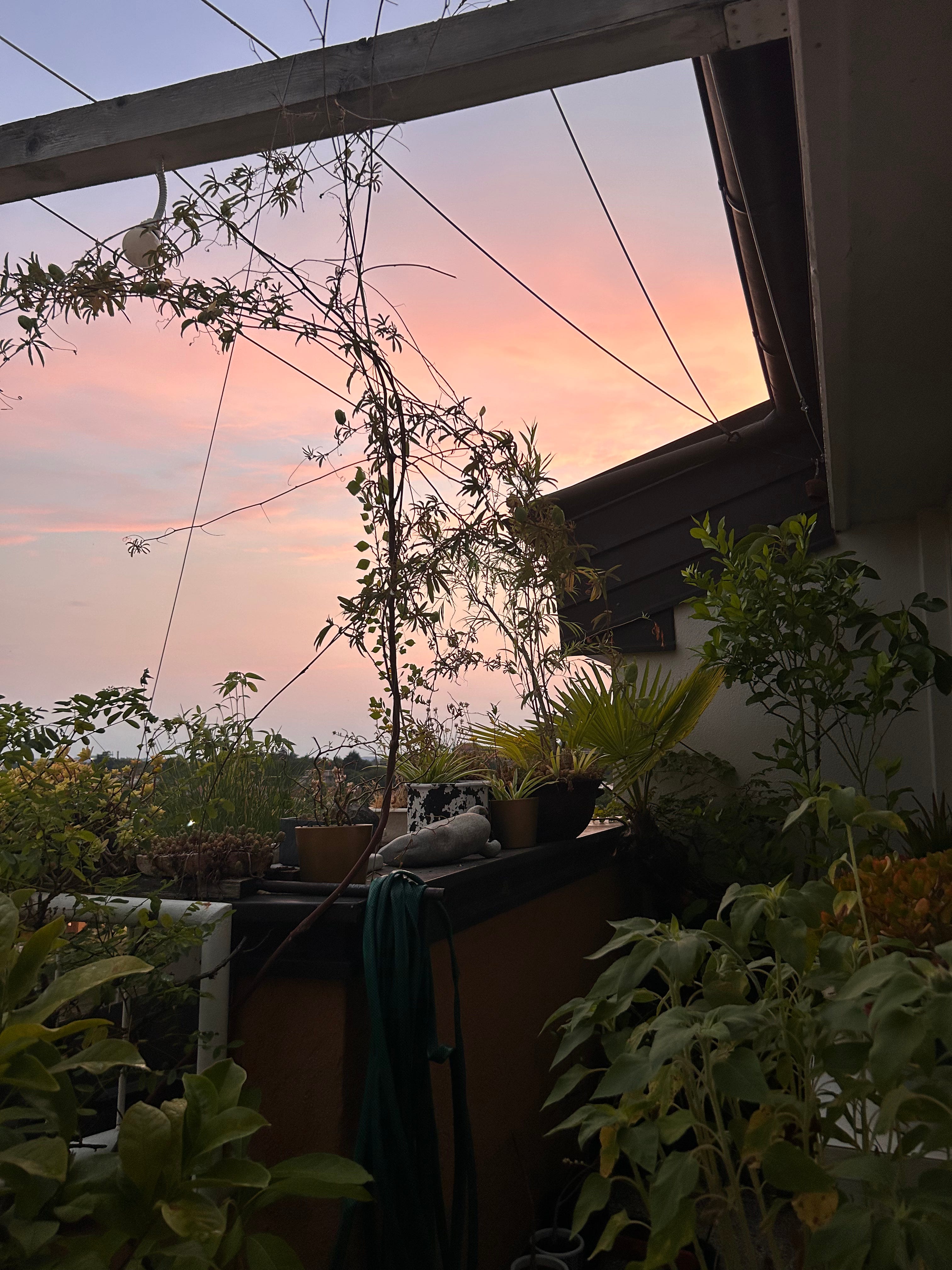
It’s been over six months since I moved out of the Cosmos’ Cabin. During this time, nature went from exploding with fruit and fragrance into fiery shades of yellow and orange, all the way to sinking back into the depths of the earth to rest. Now, I watch her change from a city balcony. The sunsets are beautiful here too.
Coming back to the valley brought an unexpected feeling inside my body: freedom. Leaving the cabin was sudden, a raw exit like being pulled from a dream. And yet, beneath the grief, something in me softened and unlatched. I was freed from the belief that the only place I could thrive was a remote forest. I had treated that life like an ideal, a final destination, a promise written in stone. But nothing like that really exists when we’re learning to surrender and trust Life.
Recently, the ideals I carry inside me have been persistently coming to the surface. Maybe it’s my dreamy, unearthly Pisces soul; maybe it’s the conditioning of a world addicted to perfection. But I have idealised many things in my life—my parents, my job, my teachers, partners, myself, humanity and Life itself—and, apparently, some I still do.
We are constantly bombarded with ideas of how things should be: how our careers should look like, how our parents should have loved us, how grief should be processed, how happiness should be constant, the partner who always knows what to say, our bodies smooth and unwavering, daily routines set and steady, our purpose obvious and triumphant. The world is full of instructions, spoken and unspoken, on the “right” way to be human. And when real situations reveal our limits, we are left with nothing else but disappointment.
Ideals rob us of the chance to be with what is actually present: the tremble in our voice, the sweetness in someone’s eyes when they’re trying, the messy conversations that don’t go as planned, the stumbles, the repairs, the tiny miracles of people choosing each other anyway, the chaos of being alive. The beauty and the pain of being human.
A few days ago, I read one of those modern psychology posts about “finding the right person”. It sounded like a product list of desirable qualities: your nervous system should feel safe around them, your heartbeat should slow, they should listen patiently and always apologise, never run when things get messy etc. Part of me longs for this so deeply. And another part feels the pressure of it, like a hand tightening around my chest.
The truth is that most of the time, we run or yell or freeze not because we don’t care, but because we are simply hurting and don’t know what to do with it.
What if, instead of demanding that others be healed before we love them, we became a safe place for them to land? A quiet room where their pain—whatever the form—can take off its shoes and rest.
And when we don’t succeed and we run or yell or freeze, we create that quiet room for ourselves and our own pain.
What if love made room for us, not ideals?
One definition of ideal is “existing only in the imagination; desirable or perfect but not likely to become a reality.” Reading that feels sobering, and strangely relieving.
So, maybe being in relationship with what is already here is the way forward. The warm tea cooling too fast in my hands. The person who is trying but still hurts me. The part of me that reacts from insecurity, even though I have promised to myself I won’t do that again. Maybe this is the sacred ground—the ordinary altar where pain and joy do not need to cancel each other out. And where a sincere “I’m sorry” is one of the highest forms of expressing love.
Observing ideals surfacing in the recent times, I have noticed that acting from them often feels like a cage. But when I address them consciously, something softens. I feel it physically—like a loosening in my chest, like the first inhale after crying. Pain and beauty sit beside each other again. Holding my shadow feels like the only way to stand in the light.
“The way forth is not to dissociate from the patterning of the usual life with the usual patriarchal advice to go to an “inner state” to deal with the “outer state”. This caused the problem in the first place. No! The way forth is to associate positively to the mere patterning. Be free in its dark midst. Have a friendly and intimate relationship with everything: even pain or someone else’s anger. Acknowledge the fact of the situation and be present to it.” — Mark Whitwell
Cosmos’ Cabin was one of those life experiences that opens you for real life. For the life I want to live—one where I am in relationship with everything and everyone. I needed to live that ideal fully in order to see I could thrive without clinging to it.
I’m grateful.
My desire to live close to nature is still alive. It flickers like candlelight in my ribs. It’s just more like a companion dream I can hold gently, not grip. Something that does not prevent me from being fully alive in a one-bedroom apartment and with the ring road below the neighbourhood.
And I wish you to have your desires too. To dream big while indulging yourself in the beauty and pain of this exact moment. Your Life is already happening.
I feel it is time to bid you a fond farewell and conclude this chapter. Take it as a soft doorway.
A quiet bow.
A thank you.
And then, onward. Into what is here.
Maja, hvala za celoten opus, ki ga je dal Cosmo Cabin, se veselim brati karkoli bo (če bo) v prihodnosti spet prišlo na papir 🫂
❤️❤️❤️
The view is awesome!